Your Purpose. Our Passion.

Friday
Apr042025

Special Update: Tariffs and Market Volatility

Sean Gross, CFP®, AIF® | Co-Founder & CEO

When all the experts and forecasts agree - something else is going to happen.1

Yesterday, President Trump announced new tariffs on nearly all major U.S. trading partners. These tariffs are “reciprocal,” on top of previously announced duties. These tariffs have had an immediately negative impact on the stock market and have caused a number economists to increase their recession probability forecasts.

Navigating Market Volatility: Staying Focused on Long-Term Success

These trade changes are an ongoing process, and it will take time to see their full effects. While stocks are volatile in this uncertain period, bonds are holding up, showing the power of diversification.

Investors have faced many challenges over history, including the pandemic, inflation fears, wars, recessions, bubbles, political turmoil, and technological disruptions. In every case, markets went on to new highs, even if it took some time.

Key Facts

To help cut through the noise, here are some of the biggest developments and issues from the tariff announcement:

  • The immediate stock market reaction is negative, with the S&P 500 declining ~6% from 4/2/25 through ~10 AM on 4/3/25. Partially offsetting this, bonds have gone up, and the falling US dollar has helped international exposures.
  • The newly announced tariff measures have been set at a minimum 10% rate, and the average tariff rate across countries is 25%, with rates for some countries as high as 49%. The level and scope are greater than many investors and economists expected.
  • This all comes at a time when consumer and investor sentiment is low. Concerns currently include higher inflation and a possible recession, although uncertainty remains around policy implementation timelines and economic effects.
  • At a company level, some U.S. manufacturers might benefit from less foreign competition. Conversely, about 30% of large U.S. companies' sales come from overseas, so changes in trade rules could impact their business. Many companies are already adjusting their operations in response.
  • Given limited visibility into trade policy outcomes, the Federal Reserve has maintained interest rates, viewing tariff effects as "transitory" one-time events. If needed, the Fed could step in to support markets.
  • When it comes to asset allocation, diversification has helped investors so far in 2025. Various asset classes—including bonds, international stocks, and some alternative investments—have helped support balanced portfolios during this period of stock market volatility.
  • Nobody really knows how the tariffs are going to affect long-term economic growth and market outcomes. News outlets sell headlines and economists make predictions; however, both have demonstrably poor track records. This phenomenon was humorously and ironically illustrated by a famous American economist who quipped, The stock market has called nine of the last five recessions2.


Key Takeaways and the Path Forward

If you can keep your head when all about you are losing theirs...if you can wait and not be tired by waiting...yours is the Earth and everything that's in it.3

These tariff announcements represent a major shift in trade policy. That said, successful investing isn't about reacting to headlines or trying to time market movements. Rather, it's about maintaining perspective and a flexible, well-diversified portfolio aligned with your long-term financial goals.

There are many reasons to believe markets and the economy can eventually move past the current set of concerns. It's important to recognize that this pattern falls within normal market behavior. Historically, markets have positive annual returns approximately two-thirds of the time and deliver negative annual returns only one-third of the time. Despite these occasional downturns, the stock market has demonstrated growth across decades and full market cycles.

“Keeping your head” and having the fortitude and discipline to stay invested—or, even to take advantage of more attractive valuations—is a key principle to long-term financial success.

As always, we're here to help you maintain perspective and make informed decisions about your financial future.

Endnotes:

1 Bob Farrell, former Merrill Lynch Market Technician.

2 Paul Samuelson, Economist and the first American to win the Nobel Memorial Prize in Economic  
   Sciences.

3 Rudyard Kipling, from the poem, “If”.

Wednesday
Apr022025

Liberation Day Q1 2025 Market Update

Sean Gross, CFP®, AIF® | Co-Founder & CEO

Market Environment Indicator (MEI)
MEI readings declined from last week, but the indicator remains Positive after improving from Neutral last week. The weight of the evidence suggests that the current decline is not expected to extend into a significant downtrend. If the MEI reverses to Negative, it would be a signal of more substantial problems ahead.

Liberation Day
The S&P 500 and Nasdaq have recently had some of their worst days since 2022. If you’re following the news headlines, you have likely seen that the explanation for recent market volatility and losses is due to the anticipation of President Trump’s “Liberation Day” tariffs announcement. By the time you read this, the tariffs will have been announced, and the U.S. market reaction will be seen in tomorrow’s (4/3) trading. Times like these can feel uneasy, so I wanted to write a brief note to share my perspective. I hope you find this helpful, but please always feel free to reach out with any questions.

Understanding Market Concerns
While tariffs have been front and center amid recent market volatility, other economic data is adding to market concerns. It’s important to note that slow growth is part of the business cycle and doesn’t necessarily mean the cycle is ending.

Here are some important perspectives:

  • Recession Forecasts: In recent interviews, President Trump did not rule out the possibility of a recession. Some investors and economists have been worried about a recession for the past three years. Just a year ago, many believed an economic downturn would be imminent due to inflation. Despite these fears, the stock market has performed well over this period with the S&P 500 still up nearly 60% since the bottom in 2022, and 10% over the past year. It’s important to take these forecasts with a grain of salt.
  • Economic Policy Changes: New tariff policies have created market turbulence, although historical evidence suggests their long-term economic impact may be less severe than initial market reactions indicate. For example, in 2018 the market fell as tariffs were implemented, but earnings growth was still strong, and GDP was almost 3% that year. Eventually, new trade deals were reached.
  • Inflation Concerns: The Consumer Price Index rose above 3.0% for the first time since last summer but has fallen slightly since then. This affects both consumer sentiment and spending patterns. Inflation has been closely watched for several years as it is a key consideration for how the Federal Reserve directs interest rates. Elevated inflation will make it difficult for the central bank to cut interest rates if the economy begins to slow.
  • Employment Changes: Recent federal government layoffs have caused some concern, with the latest employment data showing a decrease of 10,000 federal jobs, though this number is likely to rise in future reports. While federal workers account for less than 2% of the workforce, there is concern of ripple effects on the private sector and job growth overall. Overall job growth remains positive, with unemployment still near historic lows.
  • Consumer Sentiment: Survey data shows increased pessimism about future financial conditions, with inflation expectations reaching levels not seen since 1995. While this could impact future spending, how consumers feel can change quickly as well.


Maintaining Perspective
The potential for some period of turbulence as trade policy takes shape can be challenging. However, the pro-growth policies that had excited markets last year are still on the table. For example, an extension of the Tax Cuts and Jobs Act (TCJA) is currently being considered by Congress and significant pro-growth regulatory changes are in progress.

Market declines are never pleasant, but they are a normal part of investing. History shows that staying invested through challenging periods has typically rewarded patient investors.

Looking Forward
While tariff and recession concerns have increased, it's crucial to remember that economic forecasts are often unreliable timing indicators for investment decisions. What’s more important is holding a flexible, well-constructed portfolio that can withstand all parts of the market cycle. Please be on the lookout for additional communications in the weeks ahead, including my next letter which will explain how our investment philosophy and strategy are specifically designed, and particularly well-suited, for uncertain market environments.

Ultimately, current market conditions may feel uncomfortable, however maintaining a long-term investment perspective is still the best approach to achieving your financial goals.

Friday
Mar172023

The Impact of SVB’s Collapse on Disruptive Innovation

Sean Gross, CFP®, AIF® | Co-Founder & CEO

If there is one common theme to the vast range of the world’s financial crises, it is that excessive debt accumulation, whether by the government, banks, corporations, or consumers, often poses greater systemic risks than it seems during a boom.

— Carmen Reinhart, Professor of the International Financial System at Harvard Kennedy School

Disruptive Innovation

Disruptive Innovation, as an investment theme, describes the investment opportunity presented when the introduction of an innovative product or service transforms an industry, upsets existing structures, creates greater efficiency, and makes sophisticated products and services accessible, and often more affordable, to a broader market.

Amazon (AMZN) is widely recognized example of disruptive innovation. In its first incarnation, AMZN disrupted book selling, then online retailing, then video and music content delivery, then grocery delivery, etc. As it innovated and grew its services, it created greater buying efficiency, lower costs for consumers, and ultimately greater demand for everything it offers to sell us, much of which we didn’t even know we needed! The business of AMZN, and of every disruptive innovator, is very capital intensive. If not for the capital provided through bank lending, and investor’s willingness to buy the stock and bonds of these companies, there would be much less, if any, disruptive innovation, and much less, if any, growth of investment capital.

Silicon Valley Bank Collapse

Over the last year, rapidly increasing interest rates drastically reduced the value of all existing bonds, including US Treasuries (bond values generally decrease as interest rates increase). Most banks invest their excess capital in Treasuries. Silicon Valley Bank (SVB) was especially vulnerable because of its non-diversified customer base. Most of SVB’s customers were venture capital firms and startup companies, especially in the technology sector, which are extremely capital intensive and unprofitable. According to Bloomberg News, almost 50% of all US startup companies backed by venture capital banked with SVB, in addition to 44% of US venture-backed technology and healthcare companies that went public last year.[i] (think: Disruptive Innovators).

Rapidly increasing interest rates made it more difficult for SVB to find profitable lending opportunities in these sectors (this is one of the main reasons the tech-heavy NASDAQ dropped over 30% in 2022). With fewer profitable lending opportunities, SVB invested most of its deposits in longer-term Treasuries to achieve higher yields. While Treasuries are considered “risk-free” if held to maturity, their market value still declines when interest rates rise. As SVB’s depositors began to withdraw their money, SVB was forced to sell Treasuries to meet depositor demand, resulting in $1.8 billion loss on its Treasury bond portfolio. Unable to absorb further losses by selling Treasury bonds, SVB unsuccessfully attempted to raise capital through the issuance of additional shares of common stock and convertible preferred stock.

Interpreting SVB’s inability to raise capital as a reflection of its financial weakness, depositors withdrew $42 billion in a single day.[ii] This resulted in shares of SVB Financial Group, SVB’s holding company, declining 67% through Friday of last week, before trading was halted and bank regulators seized control of the bank.

The End of Disruptive Innovation?

After a disastrous 2022 (largely due to the rapid increase in interest rates), our Disruptive Innovation strategy has been one of our best performing strategies in 2023, despite the stock market chaos created by SVB’s, and other bank failures. While we still very much believe in this investment theme long-term, we believe that caution is warranted due the failure of SVB, the likelihood of even higher rates this year, and the possibility there could be more failure among banks, especially those who specialize in financing the companies in this sector. For now, we are taking profits and redirecting the assets in our Disruptive Innovation strategy into our equally opportunistic, but much more diversified, Aggressive Unconstrained strategy.

Like the Disruptive Innovation strategy, the Aggressive Unconstrained strategy employs the Market Environment Indicator (MEI) to tactically increase and decrease risk. As I mentioned in my 3/15 letter, the MEI is currently negative. As a result, all our tactical strategies, including the Aggressive Unconstrained strategy, remain in a defensive posture with reduced market exposure and an overweight cash allocation.  

If you have any questions about bank failures and the possible impact on disruptive innovation companies, our Aggressive Unconstrained strategy, or any questions about your portfolio and the markets in general, please do not hesitate to contact me.

Thank you for giving us the privilege of serving your wealth management needs—it is a stewardship we approach with the greatest seriousness, care, diligence, and fidelity.


[i] https://www.bloomberg.com/news/articles/2023-03-13/svb-bank-failure-exposes-tech-s-venture-capitalists-to-huge-financial-risk

[ii] For comparison, Washington Mutual faced only $17 billon in withdrawals over two weeks in 2008.

Monday
Oct312022

The Election and The Markets

Sean Gross, CFP®, AIF® | Co-Founder & CEO 

The Election

Freedom is the freedom to say that two plus two make four. If that is granted, all else follows. – George Orwell, “1984”

I passionately urge all readers of this letter, who are registered to vote, to proudly exercise your freedom to vote on or before November 8. If you are not registered to vote, please consider becoming registered, so that you can participate in deciding the future of our great country. If you don’t vote, you don’t get to complain!

From my perspective, there has never been a more consequential election in U.S. history. Regardless of one’s political leanings, one thing is clear: America is advancing away from constitutional democracy and toward Socialism[i] faster than at any other time in our history. Most glaringly, from an economic perspective, mathematical facts such as two plus two makes four, are increasingly, and recklessly, being disregarded. There is, perhaps, no greater evidence of this madness than the insistence of many U.S. politicians that America can borrow our way to a more profitable future, entirely at tax-payer expense (i.e., at the expense of our children and grandchildren). How long can a household survive when it continually spends more than it takes in?

A recent example of this misguided thinking is the so called “student loan relief plan” which, according to economists Brian Wesbury, Robert Stine, Strider Elass, Andrew Opdyke, and Bryce Gill is expected to add at least $426 billion to the federal deficit.[ii] These same economists note that, with the exception of the COVID years, FY2022 [9/30/21 – 9/30/22] spending as a share of GDP was the highest for any year since World War II[iii]. To make matters worse, all this spending occurred while the economy was expanding, a pattern which violates even the Keynesian economic theory[iv] that government should borrow in periods of economic contraction (i.e., recession) and then pay back the debt during times of economic expansion. Instead, our government has been borrowing record amounts while the economy is expanding. For more than two centuries, America’s consistent fiscal pattern has been to reduce federal debt when the economy is expanding. There has never been this much spending during a time of economic expansion in U.S. history. How are we going to pay back the debt when the economy is in a recession? 

If one regards inflation as an evil, then one has to stop inflating. One has to balance the budget of the government.– Ludwig von Mises, “Economic Policy: Thoughts for Today and Tomorrow”

Every American has the right to vote their conscience, without fear of reprisal, being “cancelled”, or being bullied. I am not ashamed to share how I will be voting because I sincerely believe the following issues matter greatly to the survival of our republic, and thus the freedom, success, and prosperity of every American. I am voting for candidates that demonstrate a solid understanding of economic principles and the  evil of inflation, are committed to putting America’s economic and security interests first, and pledge to, and have a credible history of, strongly defending freedom of speech and the rule of law.

The Markets

Our Market Environment Indicator (MEI) recently turned positive, resulting in an increase in market exposure and a reduction in cash in our tactical strategies. Strong rallies are quite common in bear markets, so it’s too early to tell if this is a false signal, or if we have entered a new cyclical bull market. For now, we are cautiously overweight risk assets while waiting to see if the bear market is really over, or has further to run. Even if this is only a bear market rally, eventually a rally like this will mark the start of a new cyclical bull market. Trying to predict if this will be a sustainable rally is impossible. Instead, our approach focuses on adjusting portfolio risk exposure based on what the MEI is telling us, versus trying to anticipate what the market is going to do in the future.

We are deeply grateful for the privilege of serving your wealth management needs—it is a stewardship we take most seriously. 


[i] Though some prefer the term progressivism for the political movement that views the government as the solution to America’s problems, I believe this is a dangerous canard. Even if one disagrees with this conclusion, history suggests that progressivism leads to socialism and socialism leads to communism. 

[ii]Drop in Budget Deficit is a “Sugar High”, https://www.ftportfolios.com/Commentary/EconomicResearch/2022/10/31/drop-in-budget-deficit-is-a-sugar-high

[iii] Ibid

[iv] Keynesian Economics Theory: Definition and How It's Used, https://www.investopedia.com/terms/k/keynesianeconomics.asp


Friday
Jun172022

Market Environment Update, Summer 2022

Sean Gross, CFP®, AIF® | Co-Founder & CEO 

Summer is finally here, or is it? While summer doesn’t officially arrive until Tuesday, June 22, I’m using “Summer” in the name of this letter for two reasons: 1) by the time you read this, the summer solstice will have likely already occurred; 2) I’m looking beyond our seemingly endless spring (or, is it winter?!) with optimism and hopefulness that warm weather will finally arrive on the longest day of year! Regarding the summer solstice, I am always a little discouraged when I realize, just as warm weather arrives and my plans for summer fun begin, the days get progressively shorter. I still have a very hard time accepting this! 

In our Winter 2022 letter, I wrote the following…

Following the market lows of March 2009, the S&P 500 has generated an average gain of 18.6% per year, which is well above the long-term average annual gain of 9.7% since 1927. This statistic alone suggests that the U.S. stock market cannot continue at the pace of the last 12+ years. There will be a reversion to the long-term average gain, and a reversion to the long-term average means there will be years in which the market produces returns which are significantly less than the long-term average, including negative returns.

Our Market Environment Indicator (MEI) turned negative last week, resulting in a reduction of market exposure and an increase of cash allocations in our tactical strategies. It is too early to tell if this is a false signal, if the market has entered a short-term correction, or if it is the beginning of a long-term bear market.

We now know the MEI reversal to negative in January was definitely not a false signal: Since the beginning of 2022, the broad U.S. stock market, as represented by the S&P 500, has lost over 23%. What we do not yet know is if this is merely a cyclical (short or intermediate term) correction, or the beginning something much worse and longer term. Like every other so called “expert” in this business, I don’t know! While I wish I could offer more encouraging news, I would be speculating and to paraphrase Mark Twain: June is one of the peculiarly dangerous months to speculate in stocks. The others are July, January, September, April, November, May, March, June, December, August and February.

If you spend more than 13 minutes analyzing economic and market forecasts, you've wasted 10 minutes.[i]

Heeding the sage advice of Peter Lynch, I'll spend less than 3 minutes of your time telling you I believe the market is likely to get worse before it gets better. While there will certainly be short-term periods of positive performance, the overall trend of the market remains negative, i.e., the MEI has not yet signaled that it’s safe to increase market exposure. Until it does, we remain very cautious, with high cash balances and low market exposure in our tactical account investment strategies.  

Inflation is always and everywhere a monetary phenomenon.[ii]

Moving on from the stock market to the economy, I feel compelled to write on the subject of “inflation.” I intentionally put inflation in quotes, as I believe the phenomenon of what is commonly called inflation is tragically misunderstood. I began this section with a quote from Nobel Prize winning economist Milton Friedman. I’d like to expand on Friedman’s claim by quoting my favorite economist, Ludwig von Mises, who may be the most hated and most understudied economist of all time, at least among today’s MMT-centric[iii] economists, whose radical theory may have irreversibly transformed U.S. government economic policies, with devastating financial consequences for American households…

Inflation, as this term was always used everywhere and especially in this country, means increasing the quantity of money and bank notes in circulation and the quantity of bank deposits subject to check. But people today use the term `inflation' to refer to the phenomenon that is an inevitable consequence of inflation, that is the tendency of all prices and wage rates to rise. The result of this deplorable confusion is that there is no term left to signify the cause of this rise in prices and wages. There is no longer any word available to signify the phenomenon that has been, up to now, called inflation…As you cannot talk about something that has no name, you cannot fight it. Those who pretend to fight inflation are in fact only fighting what is the inevitable consequence of inflation, rising prices. Their ventures are doomed to failure because they do not attack the root of the evil. They try to keep prices low while firmly committed to a policy of increasing the quantity of money that must necessarily make them soar. As long as this terminological confusion is not entirely wiped out, there cannot be any question of stopping inflation.[iv]

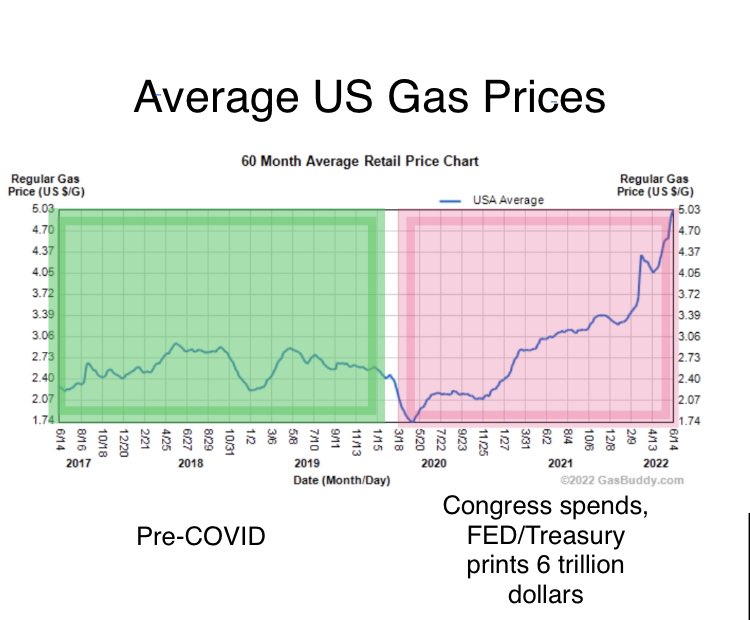
What von Mises was trying to explain is that inflation (an increase in the money supply) is the cause of rising prices vs. the phenomenon of rising prices. What people commonly call “inflation” today (i.e., rising prices) is actually the result of inflation (i.e., an increase in the money supply). This is a very important distinction, especially as America wonders, how did we get here? It seems quite evident that it did not start with supply chain issues or a war in Ukraine. To illustrate this, in the following chart note the exponential increase in gas prices corresponding with the unprecedented increase in federal spending (i.e., actual inflation, per Friedman and von Mises) beginning with the U.S. economic shutdown at the beginning of the Covid-19 pandemic…

Out of crisis comes opportunity. You make most of your money in a bear market; you just don't know it at the time.[v]

What might we expect to see, going forward? Remember, I don't know! However, ignoring the previously cited wisdom against speculation, it would seem that negative U.S. stock market performance is reflecting economic weakness which is now present and likely to get worse. In fact, some of those who keep close track of such things believe the U.S. has already entered an economic recession (two consecutive quarters of economic decline, as measured by GDP). If correct, stock market performance is likely to get worse before it gets better.  

However, if the stock market follows the historical pattern, at some point in the future--likely in the midst of even worse economic news and, most importantly, when we least expect it--disciplined investors will look beyond the then present economic conditions and put money back into risk assets, expecting better returns in the future as the economy improves. This is the pattern I’ve witnessed countless times in over 32 years in the money management business. If this pattern repeats, I suspect it will not be immediately observable, let alone believable, and the majority of investors will be reluctant to commit investment capital. In the scenario I’m describing, I expect that demand for risk assets will slowly, quietly resume while the financial prognosticators are still talking about the end of the world! When this occurs, our Market Environment Indicator (MEI) will guide us, as it has so many times in the past. Until then, we remain cautious, hopeful, and entirely confident in the observation of Shelby Cullom Davis: Out of crisis comes opportunity.

Summer has arrived!


[i] Legendary investor Peter Lynch, former manager of the Fidelity Magellan Fund, who is widely considered one of the most successful and well-known investors of all time.

[ii] Milton Friedman, “Inflation Causes and Consequences”, Asian Publishing House, 1963

[iii] Modern Monetary Theory (MMT) is a [non mainstream]…economic framework that says monetarily sovereign countries like the U.S., U.K., Japan, and Canada, which spend, tax, and borrow in a fiat currency that they fully control, are not operationally constrained by revenues when it comes to federal government spending. Put simply, such governments do not rely on taxes or borrowing for spending since they can print as much as they need and are the monopoly issuers of the currency. Since their budgets aren’t like a regular household’s, their policies should not be shaped by fears of a rising national debt. (https://www.investopedia.com/modern-monetary-theory-mmt-4588060)

[iv] “Inflation, An Unworkable Fiscal Policy”, Ludwig von Mises

[v] Shelby Cullom Davis, one of the greatest value investors the world has ever known.

Page 1 ... 8 9 10 11 12 ... 14 Next 5 Entries »